
 John Smith
 A pro-grade, soy-based lube that cuts residue and environmental guilt — at a small premium.
A backyard arborist who dreads oil stains on boots and the sight of rainbow sheen on a neighbor’s pond would welcome a lubricant that’s both tough and gentle. Conventional petroleum chain oils do the job, but they leave sticky residue, track everywhere, and raise environmental concerns — a real pain point for professionals and hobbyists who work near water or care about cleanup.
DEWALT’s soy-based Biodegradable Bar & Chain Oil positions itself as that middle ground: professional-grade protection with a smaller environmental footprint. Testers rated it 9 out of 10, praising its wide temperature range, high viscosity index, and ultraclean formula — though buyers should expect a modest price premium and be mindful of occasional packaging issues and limited availability.
DEWALT Biodegradable Bar & Chain Oil 16 oz
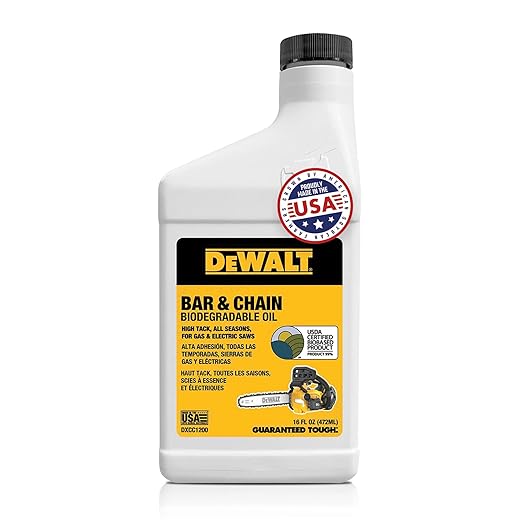
A high-performance, soy-based lubricant that balances professional-grade protection with reduced environmental impact. It delivers reliable lubrication across wide temperatures while leaving less residue than conventional oils, though buyers should expect a modest price premium and watch for packaging when ordering online.
How DEWALT Bar & Chain Biodegradable Oil Is Changing the Game
Overview
DEWALT’s biodegradable bar and chain oil is formulated for professionals and conscientious homeowners who need dependable lubrication without sacrificing environmental responsibility. The 16 oz bottle contains a soy-based, ultraclean lubricant designed for gas, electric, and pole saws. It is engineered to perform in a wide thermal window and to minimize the environmental footprint when used in loss applications such as chain oiling.
What It Is Made Of and Why It Matters
This bar and chain oil is made primarily from plant-derived oils, specifically soy-based feedstocks. Its non-toxic formulation is created to biodegrade more readily than conventional petroleum oils, which is an important distinction for users working near waterways, parks, or in contexts where oil will inevitably be dispersed into the environment.
Performance Highlights
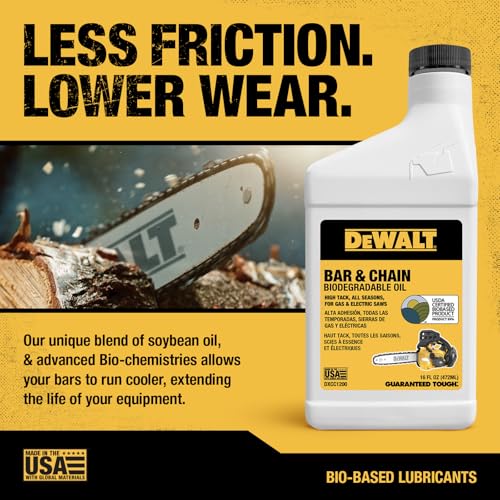
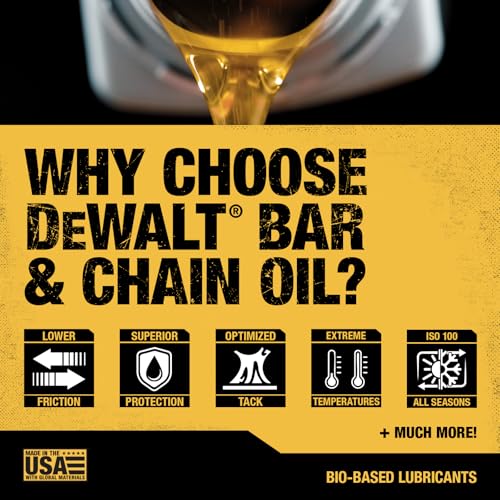
DEWALT’s formula targets three core performance areas: friction reduction, thermal stability, and cleanliness. The manufacturer reports a viscosity index up to 300% higher than many conventional petroleum chain oils. Practically, that translates into more consistent lubrication across temperature extremes and reduced metal-to-metal wear on the bar and chain.

Typical Use Cases
This oil is suitable for a wide range of users and machines, including:
Application Tips & Best Practices
Using a biodegradable oil still requires the same attention to basic maintenance to get the best life from the chain and bar:
Packaging & Handling
The product comes in a 16 oz plastic bottle with a spout designed for controlled pouring. Users should be aware of shipping and packaging considerations: a small percentage of reviews report transit damage or leaking bottles. Inspect the bottle upon delivery and report any damage to the seller immediately.
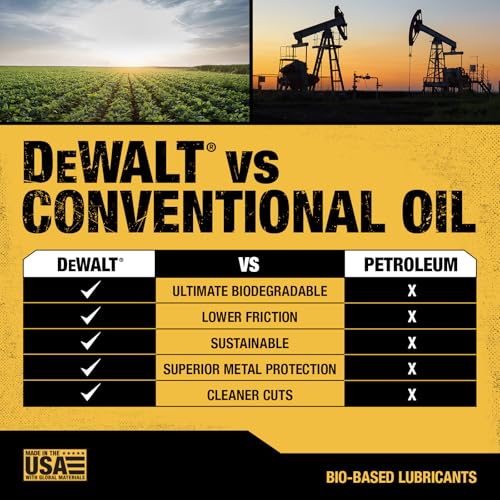
Quick Comparison: DEWALT Biodegradable vs. Conventional Petroleum Chain Oil
| Feature | DEWALT Biodegradable Oil | Typical Petroleum Chain Oil |
|---|---|---|
| Primary base | Soy-based (biobased) | Mineral oil (petroleum) |
| Biodegradability | High | Low to moderate |
| Viscosity index | High (consistent across temps) | Lower (more variable) |
| Residue / Sling | Low | Can be high, sticky build-up |
| Environmental risk in loss applications | Reduced | Higher |
| Typical cost | Premium | Lower |
Maintenance Checklist
Troubleshooting Common Issues
Safety, Disposal & Environmental Notes
This product is formulated to be less harmful than petroleum oils in typical loss scenarios, but users should still observe standard precautions. Avoid deliberate dumping of oil into waterways or sewers.
Final Verdict & Who Should Buy It
Professionals, municipal crews, and environmentally conscious homeowners will appreciate the balance of high lubrication performance and reduced ecological impact. It is particularly suited for anyone who works near sensitive environments or wants a cleaner-running saw with less sticky build-up on the bar and chain. Buyers willing to pay a slight premium for these benefits will find this oil a worthwhile investment.
Quick Reference: What to Expect in the Box
Overall, this oil brings an effective, modern alternative to traditional chain oils: strong lubrication, good thermal behavior, and reduced environmental burden—traded for a somewhat higher price and the need to check packaging on delivery.
FAQ
Yes. The oil is compatible with gas, electric, and pole saws and fits standard oil reservoirs. It is formulated to provide similar or better lubrication than conventional oils while being biodegradable. Users should always consult their saw manufacturer manual to confirm any specific lubricant requirements.
Not necessarily. This DEWALT formulation is designed to operate from about -15°F up to 500°F. In extremely cold climates, users may want to keep an extra bottle in a warm vehicle or insulated compartment to avoid temporary thickening, but performance at low temperatures remains reliable for most users.
Yes. The ultraclean composition reduces sticky build-up and tends to sling less than many heavy, tacky petroleum oils. Results depend on chain speed, oiler setting, and cutting conditions, but many users report a cleaner saw and less residue on guide bars and hands.
This oil is designed to be less harmful in loss applications and is a better choice where environmental impact is a concern. However, it is still an oil and should be used responsibly—avoid direct discharge into waterbodies and follow site-specific environmental regulations.
Routine inspection frequency doesn’t change with biodegradable oil. Weekly visual checks during heavy use and monthly cleaning of the bar groove are standard good practice. Monitoring chain tension, wear, and sprocket condition remains important to maximize tool life.
For professionals working near sensitive environments, or for users who want less residue and better thermal stability, the price premium is justified by reduced maintenance and a smaller environmental footprint. For occasional home users with no environmental constraints, conventional oils may be cheaper but less clean-running.
Document the damage with photos, contain and clean any spilled oil, and contact the seller or carrier immediately for a replacement or refund. Inspect the rest of the package contents and keep the original packaging for claims.






I appreciate DEWALT trying to go biodegradable. A few notes from me after using soy-based chain oil:
– Lubes cleaner than typical petroleum oil, less black residue on the bar.
– Slightly higher consumption — I refill more frequently.
– Smells better (not that that matters much when you’re drenched in sawdust). 😂
One heads-up: packaging can be flimsy when ordering online. I got a dented spout once and it leaked a bit in the box.
Thanks for the real-world details, Priya. The expert verdict mentioned the packaging concern — we’ll flag that for readers to check seller packing and sealing on marketplaces.
About the smell — lol, so true. Also noticed my chain cleaner doesn’t get as much black gunk, so cleanup is easier.
Same here on the consumption — seems to run through faster, maybe due to lower viscosity or different adhesion. But I like the reduced residue.
If anyone wants, I can add a short tip in the article about checking seller photos and reviews for packaging before buying. Would that help?
Yes please — that would be helpful. A line about using a funnel or nozzle caps too might save messes.
Packaging note: I once received a bottle with the flip-top glued shut from shipping? 🤦♀️ It was annoying but the seller refunded. Just beware and check the seller’s return policy.
Thanks, Olivia — we’ve heard a couple similar reports. We’ll add a short buyer tip about inspecting packaging when the product arrives and using sellers with good return policies.
Not trying to be that guy, but how biodegradable is ‘biodegradable’? Does it break down fast enough if it drips into the soil near streams? I’m cautious because ‘biodegradable’ can be vague.
I reached out to the seller once — they said it meets certain industry biodegradability standards, but didn’t specify which. I keep a drip mat underneath when cutting near water just in case.
Thanks — that would be useful. I want to switch but also be sure it’s genuinely better for riparian areas.
I’ll see if we can get more specifics from DEWALT or their datasheet and update the article with standards or certifications if available.
Practical tip: use a catch tray for bar oil when working near sensitive spots. Cheap and effective.
Agreed — ‘biodegradable’ isn’t a free pass to dump near streams. Stay cautious.
Great point, Oliver. The oil is soy-based which generally biodegrades faster than petroleum oils, but the exact breakdown rate depends on conditions (temperature, microbes, oxygen). The manufacturer markets it as ‘biodegradable’ and ‘non-toxic’, but it’s still best practice to avoid intentional spills near waterways.
Does it play nice with electric pole saws? I don’t run gas anymore and want to avoid gumming up the gearbox.
The product is marketed for gas, electric saws, and pole saws. The soy-based formula is designed to minimize residue, which should help avoid gumming. Still, regular maintenance and occasional gearbox inspection are recommended.
I’ve used it on an electric pole saw for two seasons with no issues. Just make sure you wipe excess from the bar after use.
I gave this a try last month. Performance is solid and it smells faintly of soy — nothing offensive. No long-term wear issues so far.
Thanks for the firsthand report, Noah — did you notice any difference in chain life or bar wear compared to conventional oil after a few uses?
LOL at all the bottle stories. My takeaway: good product, watch the packaging, consider bulk if you’re a pro, and keep a backup for extreme cold. Also — can we get a scent-free option? My wife complains about any lingering smell.
Most of these oils are practically odorless compared to solvents, but there’s always a faint natural smell. Maybe try a small bottle first.
Wife here — I tolerated it just fine. But yes, small bottle trial is wise.
Thanks Henry — sentiment noted. The product is naturally soy-scented but relatively mild. I’ll ask whether a fragrance-free variant exists and update if we get an answer.
Love the cleaner residue, but it seemed to attract more sawdust to the bar in my experience — not sure if that’s oil or my technique. Anyone else notice this?
Yes — I noticed slightly more sawdust clumping on some days. I think it’s because it doesn’t leave the same sticky film that traps dust differently. A quick wipe after cutting fixed it for me.
Interesting observation. The review mentioned less residue, which usually means less hardened buildup, but how sawdust clings can vary. Good tip to wipe the bar periodically.
Could be humidity-related too. On damp days dust sticks differently — not necessarily the oil’s fault.
Has anyone compared chain stretch or tension changes when using this compared to heavy oils? My chains seem to need a tiny tweak after switching oils.
Some users report slightly different lubrication dynamics (more frequent topping-up), which can affect perceived chain tension. Regular checks and adjustments are recommended after switching oils until you get a feel for it.
I noticed minor differences but nothing dramatic. Chains still held tension as usual after proper adjustments.
Might just be that the new oil flows differently into the chain links — nothing to worry about if you adjust it.
I like that it’s non-toxic. My dog loves to roll in sawdust (don’t ask) and worrying less about toxins is a relief. 😅
Glad the non-toxic aspect helps with peace of mind. Still a good idea to keep animals away during active cutting and wipe surfaces after work.
Ha! Same here — pets and yard tools is a precarious combo. The non-toxic tag made me switch too.
Nice write-up — been looking for a greener bar oil. The soy base sounds promising. Quick question: does anyone know if it gels in sub-freezing temps? I use my saw year-round in Wisconsin and freeze-up is my main worry.
I’ve used a soy-based oil similar to this down to about 10°F without issues, but below that it got noticeably thicker. If you store it warm it’s fine. YMMV based on how old the bottle is.
I live in Minnesota — I keep mine in a heated shed and it’s been fine. If you can’t store it warm, maybe keep a small backup bottle of conventional oil for the coldest days.
Good question, Laura — the review notes ‘all-season’ performance and the expert testing showed reliable flow at moderately low temperatures, but it may thicken more than mineral oils in extreme cold. Some users add a slightly higher pour-point additive or keep the bottle in an inside pocket until use.
Long comment incoming — hope that’s ok. I run a small landscaping side gig and tried this as a test to market greener services. A few thoughts:
1) Customers liked knowing I used a biodegradable oil. It’s a decent selling point.
2) I did go through more oil on busy days — might be slightly less clingy than my old oil.
3) It absolutely left less black buildup on my bars and saws, which reduced cleaning time.
4) Packaging once arrived with a squished nozzle, so I now order extra caps.
Overall 9/10 from this end. If DEWALT tightened packaging and maybe offered larger bulk sizes for pros, I’d switch for good.
Very helpful, Rachel — thanks for sharing operational feedback. We’ll mention the pro-use case and bulk size suggestion in the suggestions section.
Exactly — a gallon option at a reasonable price would sell well, even if slightly more expensive per ounce.
Noted. I’ll see if DEWALT offers larger formats in any of their catalogs and add that to the article.
+1 on larger sizes. 16 oz is fine for homeowners but pros go through it fast.
Short and to the point: great oil, supports eco goals, but get ready to refill a bit more often. 4/5 from me.
Thanks Meena — concise and helpful. We’ll include user-consumption notes in the summary.
I love the idea, but given that it’s more expensive than bulk cheap oil, would you say the environmental benefit outweighs the cost for casual users?
For casual users, it’s a personal choice. If you do infrequent cutting, the environmental upside is modest but real. For frequent users or those near sensitive environments, the switch is more compelling.
Price seems fair for an eco option. $9.98 for 16 oz isn’t terrible.