

 Ella Clark
 They must weigh raw power against real-world runtime — will Greenworks’ 80V deliver longer run times and savings, or does DEWALT’s 60V still win on torque, durability, and consistent performance?
Surprising fact: cordless chainsaws now rival gas, and buyers must choose between GREENWORKS 80V and DEWALT 60V 18″ models. This article helps them compare real-world power, battery systems, ergonomics, safety, and value to decide confidently for homeowners and pros alike.
Everyday Yardwork

It balances strong cordless cutting power with the convenience of a battery platform, making it appealing for homeowners and light-to-medium yard work. Runtime depends heavily on battery capacity chosen, so users should plan on spare batteries for extended sessions.
Pro Powerhouse
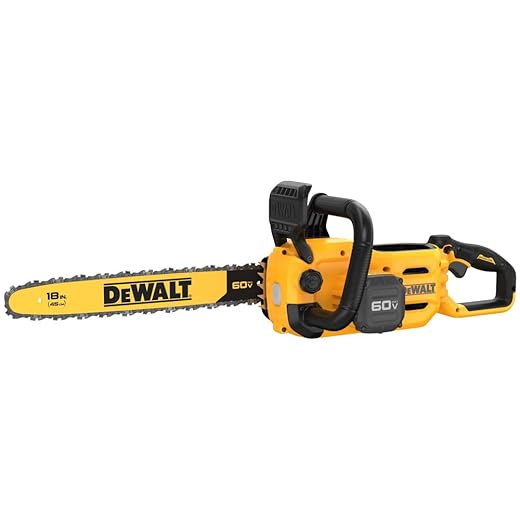
It delivers near-professional cutting power in a cordless package, suited to heavier homeowner jobs and short pro tasks. The weight and battery demands make it less ideal for prolonged continuous cutting unless multiple high-capacity batteries are available.
Greenworks 80V Chainsaw
DEWALT 60V Chainsaw
Greenworks 80V Chainsaw
DEWALT 60V Chainsaw
Greenworks 80V Chainsaw
DEWALT 60V Chainsaw
Top Battery-Powered Lawn Mower for Effortless Yard Care
Performance & Cutting Capability: Real-world Power and Speed
Motor architecture and voltage — raw potential
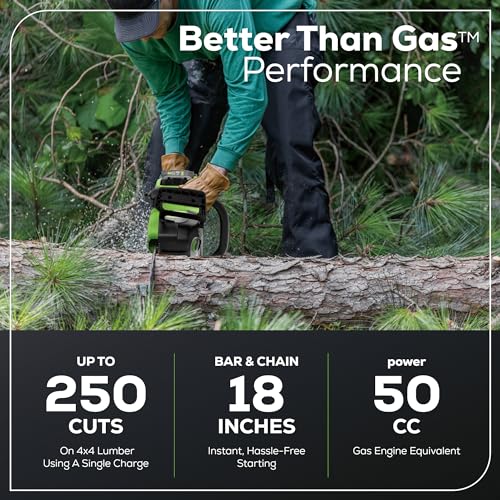
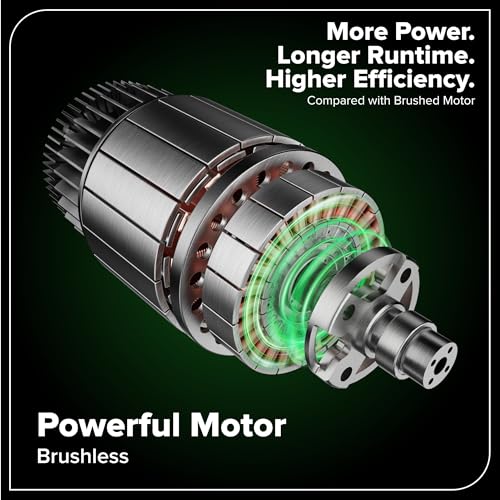
Both saws use brushless motors for higher efficiency and longer life. The Greenworks runs at an 80V platform and the manufacturer calls out “2× more torque” and equivalence to a 50cc gas engine. The DEWALT uses the 60V FLEXVOLT platform and advertises a peak 2.85 HP output (when paired with a DCB609 battery) and “up to 2.5× the torque” of a 40.9 cc gas saw. Neither model publishes a formal chain speed (ft/s) or stall-torque number for public specification sheets.

Bar, chain and effective cutting thickness
Both come with an 18″ bar and appropriate 3/8″ or .325″ class chains (model-dependent). An 18″ bar is the practical sweet spot: it handles pruning, limb removal and small-to-medium tree felling. Expect consistent, clean cuts on limbs and trunks up to roughly the mid-teens of inches in diameter; larger solid trunks require multiple passes or a longer/professional bar.
Real-world speed and sustained performance
Under short bursts and single cuts, both feel fast and responsive. The DEWALT’s higher peak horsepower and FLEXVOLT battery pairing deliver faster, cleaner cuts on continuous heavy work and large-diameter logs. The Greenworks’ 80V motor pulls strong for homeowner jobs but the included 4.0Ah battery limits sustained high-load runtime — it is more likely to slow on repeated deep cuts as battery packs heat and voltage sags.

Typical scenarios — who cuts better where
Battery System, Runtime & Charging: Compatibility and Practical Runtime
Pack contents and ecosystem
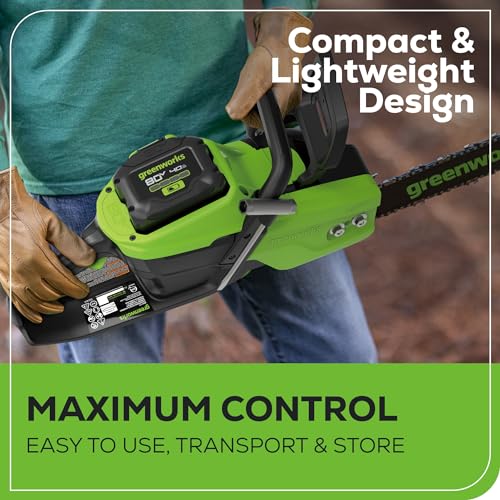
The Greenworks kit ships with an 80V 4.0Ah pack and charger and ties into a single 80V ecosystem of 75+ tools — straightforward interchangeability within that platform.
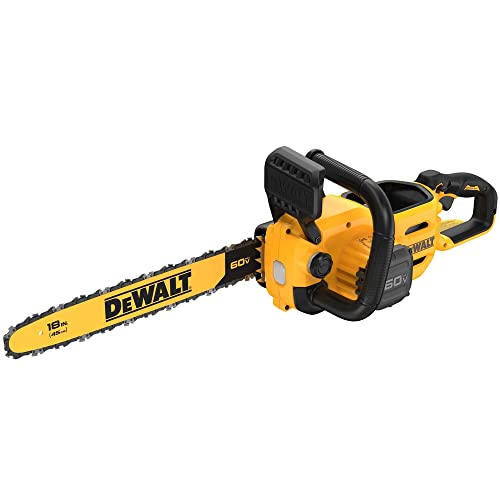
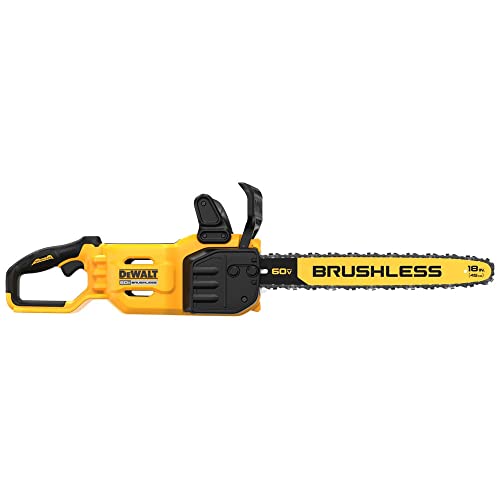
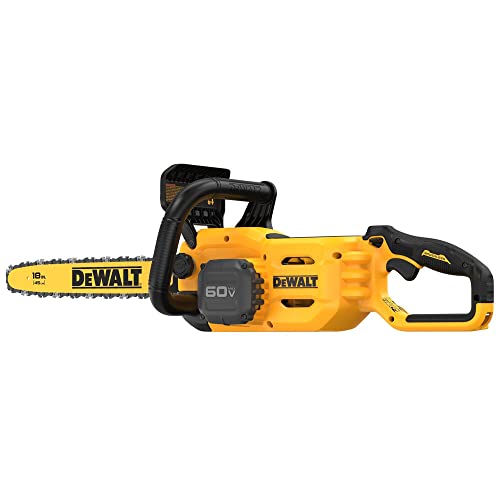
The DEWALT ships with a 60V FLEXVOLT pack (3Ah in this kit) but is designed for FLEXVOLT batteries that automatically “shift” voltage to match the tool (works as 60V in 60V tools and as lower-voltage packs in compatible 20V tools). That flexibility enables very large-capacity packs for longer runtime and higher peak output.
Energy math: how Voltage and Ah affect runtime
Use Wh (watt-hours) to compare energy: Wh ≈ V × Ah. Examples:
Real-world runtime examples (approximate)
Heavy continuous cutting typically draws ~800–1,200 W:
Charging, swapping & practical recommendations
Cooling & degradation
High-current cuts generate heat; allow packs to cool between heavy cycles, avoid complete deep discharge regularly, and store batteries cool/dry to minimize capacity loss over time.
Feature Comparison
Design, Safety & Usability: Handling, Ergonomics, and Protections
Build quality & ergonomics
The Greenworks is lightweight (~9.5 lb) with a compact body and balanced weight distribution aimed at homeowner tasks. Its slimmer profile and lower mass reduce arm fatigue during intermittent pruning and limbing. The DEWALT is substantially heavier (~18.8 lb as listed), built like a pro-grade tool: sturdier housings, more metal in critical areas, and a heft that helps drive through larger cuts but increases user fatigue on long jobs. Handles on both are wrap-style with rubber overmolds; Greenworks favors nimble control, DEWALT favors solidity and leverage.
Vibration, noise & single-hand comfort
Both saws run quieter than gas equivalents. Under heavy load DEWALT is noticeably louder and produces more torque-driven vibration; its mass dampens some feedback but becomes tiring. Greenworks shows lower apparent vibration for light-to-moderate work and is easier to manipulate single-handed for brief tasks; neither is intended for sustained single-hand operation—both are two-hand tools for safe control.
Chain brake, kickback & electronic protections
Greenworks uses a mechanical chain brake and automatic oiler. DEWALT provides a chain brake and explicit limited kickback protections plus auto-oiling. Both brushless systems reduce stall and offer inherent motor efficiency; buyers should confirm electronic overload or low-voltage cutoff in the kit manual, as these protections vary by model and battery used.
Maintenance access & tensioning
Greenworks advertises side-access tensioning and straightforward bar/chain removal with automatic oiling for easy upkeep. DEWALT provides onboard wrench storage and quick (tooled) chain adjustment; bar retention is robust for pro use.
Serviceability, parts & warranty
Greenworks includes a 4-year warranty and a growing 80V parts ecosystem. DEWALT benefits from a wide dealer/service network and readily available parts; warranty terms vary by product/retailer—check the kit documentation.
Cost, Value & Recommended Use Cases
Price-to-performance snapshot
Greenworks kit: ~$370 with a 4.0Ah battery and charger.
DEWALT kit: ~$419 with a 3.0Ah FLEXVOLT battery and charger.
DEWALT delivers the higher peak output (2.85 HP) for ~13% higher up-front cost; Greenworks includes the larger-capacity battery, so initial runtime favors Greenworks.
Total cost of ownership (batteries, spare chains, accessories)
Resale value & accessory availability
Buyer-profile recommendations
Prioritize DEWALT for maximum power, Greenworks for ecosystem flexibility and lower near-term cost.
Final Verdict: Which Should They Choose?
They should pick Greenworks if they prioritize a wider 80V ecosystem, lower entry cost with the included 4.0Ah kit, and strong cutting performance for yard work; Greenworks wins for homeowners and budget-conscious power users. DEWALT edges out for professionals and heavy-duty users who need FLEXVOLT interoperability, slightly better sustained torque, and proven commercial durability.
Final winner: Greenworks for most buyers due to value and ecosystem breadth, but DEWALT is the right professional investment. Actionable advice: choose Greenworks for the wider 80V ecosystem and included 4.0Ah kit. Choose DEWALT for FLEXVOLT compatibility and long-term professional FLEXVOLT investment. Which model will they choose to future‑proof their toolkit and maximize return on investment over years? They choose.




Bought the DEWALT for serious logs and the Greenworks for the neighbors’ weekly ‘can you cut this?’ requests. Best relationship decision I’ve made. 😂
Dual-saw approach works well for many folks. Just remember to maintain both chains and rotate batteries to keep them balanced.
LOL same — two-saw setup solves everything. One for heavy lifting, one for the quick tidy-ups.
I’m leaning toward the DEWALT 60V. FLEXVOLT seems engineered for more grunt — heard it’s the better choice for tree felling and heavier limbs. The Greenworks might be great for regular yardwork, but when you’re cutting big stuff, I’d trust the Dewalt motor and build quality.
Also, does anyone else think the 80V marketing is just ‘bigger number = better’ vibes? 🤔
Good point — higher nominal voltage doesn’t always equal better real-world performance; DEWALT’s FLEXVOLT behaves differently because of its battery chemistry and design. For consistent heavy cuts, many pros prefer the DEWALT, but Greenworks offers great value and a big tool ecosystem.
I agree — saw both in action at a demo day. Dewalt felt like it kept its speed under load better, but it was also a bit heavier.
Yep, it’s complicated. Voltage, Ah, motor tuning, and chain geometry all matter. Don’t fall for just the biggest number.
Not just marketing — but also depends on battery capacity and motor tuning. Dewalt’s 60V pack can deliver continuous high current, so it often outperforms some higher-voltage competitors in certain tasks.
Quick question from a newbie: the Greenworks listing says 4.0Ah battery included. How long does that realistically last for cutting mid-size firewood (like 8–12″ rounds)? Would I need two batteries or just frequent charging?
I’ve only used corded electric before so battery runtime is a black box to me.
Good question. Runtime varies a lot with wood species, chain sharpness, and cut size. For 8–12″ hardwood rounds, expect the 4.0Ah to handle maybe 20–40 cuts (very approximate). If you plan multi-hour sessions, get a spare battery or a higher-capacity pack.
For me hardwood eats batteries fast. I always keep a hot spare on hand. Also try to keep the chain sharp — big difference.
If you’re mostly doing smaller limbs and pruning, the 4.0Ah will be plenty. For pro-level or bigger firewood days, a second battery is a must IMO.
Great write-up — helped me finally decide! I went with the Greenworks 80V mostly because it comes with a 4.0Ah battery and charger out of the box, and I like the idea of a big ecosystem (75+ tools sounds tempting).
Pros I noticed: lighter than I expected, decent punch for pruning and small felling, and no noise complaints from the neighbors. Cons: I wish the included battery was a 5Ah or higher for longer sessions.
Anyone else using the 80V for heavier firewood duty?
I swapped in a spare 5Ah from the same Greenworks line and it made a noticeable difference. More runtime and less stressing about charging between cuts.
Yep — having a spare battery is game-changing. Also, double-check blade sharpness; a dull chain murders runtime and makes the saw work harder.
Thanks for sharing, Maya — glad the article helped. The included 4.0Ah is fine for light-to-medium work; for bigger firewood jobs people often add a higher-capacity battery or a spare battery to swap. If you plan long felling sessions, a 5Ah+ or two batteries is ideal.
Compatibility question: does the DEWALT 60V FLEXVOLT battery work with older Dewalt 20V tools? I read something about the battery ‘downshifting’ but not 100% sure. Also, how modular is Greenworks — like, can I use the 80V battery on smaller tools?
Would love someone to clear this up — battery confusion is real.
Good questions. DEWALT’s FLEXVOLT batteries can change voltage depending on the tool (they work with certain 20V tools), which is one of FLEXVOLT’s selling points. Greenworks 80V batteries are generally for that platform — Greenworks also offers lower-voltage lines but they aren’t always cross-compatible. Always check model-specific compatibility before buying.
Short version: FLEXVOLT is more versatile with some legacy DeWalt lines; Greenworks is broad but sticks to its platform voltages. Read the compatibility chart on the manufacturer page to be safe.
A few safety/maintenance tips for anyone deciding between these:
– Always wear eye + ear protection and chain-rated chaps.
– Keep chain tensioned correctly — both saws will eat batteries faster with a loose or overly tight chain.
– Learn how to do a quick field sharpen; a sharp chain saves time and battery.
Personally I think either option can be safe and effective if you follow the basics. Don’t get cute trying to power through with a dull chain.
And don’t skip the manual 😅 so many people think ‘it looks like a saw, I got this’ then forget the little details.
Also: torque down the bar nuts properly after adjusting tension. Over- or under-tightening can cause problems on both brands.
Pro tip: carry a spare chain or two for long days. Nothing worse than getting halfway through a job and realizing your chain is toast.
Excellent list, Olivia. I’d add: check the chain brake functionality regularly and store batteries in a cool, dry place to maximize lifespan.
Price-wise, factor in ecosystem cost. Greenworks gives you a lot of compatible tools for that 80V platform, which can save $$ long term if you expand. Dewalt’s FLEXVOLT is pricier but often holds up better in professional use.
If you’re buying one-off, Dewalt might be overkill. If you’re building a battery garage, Greenworks might be smarter unless you already own DeWalt batteries.
I switched my mower and blower to the same Greenworks line — saved me from buying extra chargers. Economies of scale!
If you have DeWalt 20V stuff already, FLEXVOLT can be attractive because of backward compatibility (and its unique battery tech).
Spot on. Buying into an ecosystem is a strategic choice. Also consider battery cross-compatibility with your other tools — that often drives the final decision more than raw saw specs.